
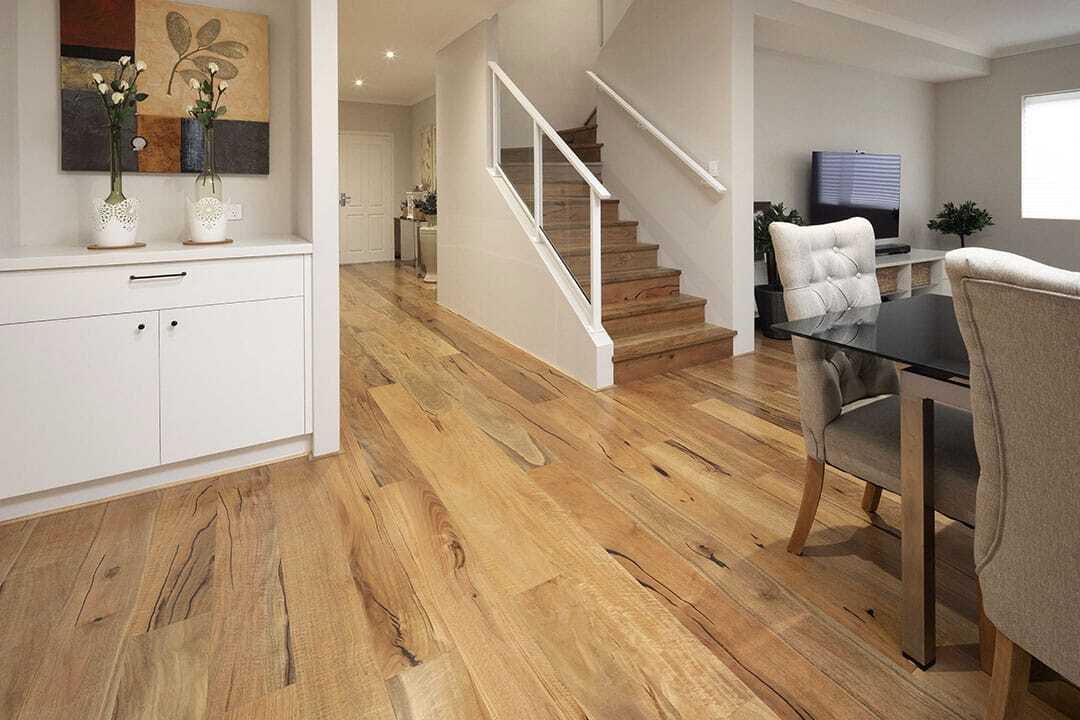
Marri is a large hardwood eucalypt, Corymbia calophylla, that grows only in the south-west corner of Western Australia. It is known for heavy gum veining, a honey-to-deep-brown colour range, a density of about 855 kg/m³ and a Janka hardness of 7.1 kN.
If you are here because you are choosing a floor, skip to the last section. Most of what follows is about the tree and the timber, because that is what people actually ask.
The tree
Marri is one of the defining trees of the south-west. It grows alongside jarrah and karri across the region, reaching a large size, with rough grey bark and cream flowers that draw birds in summer.
The name comes from the Noongar language. It is sometimes called red gum, which causes endless confusion, because the red gums of eastern Australia are entirely different species. If you see "WA red gum" on a price list, it means Marri.
Its ecological role in the south-west is significant. Marri is a food source for black cockatoos, which feed on the large woody fruits, and older trees develop the hollows those birds nest in.
The timber
Marri is a dense hardwood, around 855 kg/m³ when seasoned, and rates 7.1 kN on the Janka scale — harder than French oak at about 6.5 kN, softer than Australian species like blackbutt at 9.1 kN and spotted gum at about 11.
The colour runs from pale honey and cream through to deep brown, often within the same board.
The defining feature is gum. Marri is high in kino — the dark resin a eucalypt produces in response to injury — which collects in veins and pockets through the timber. Those veins are the reason Marri looks the way it does, and the reason it has always been difficult to work commercially.
Why gum veins matter so much
In a log, a gum vein is a void or a resin-filled seam. When the log is opened on a saw, many of those veins split, and the board around them is downgraded or discarded.
Published industry assessments describe Marri as high in gum, with low recovery rates of first-grade timber. That is not a marketing position, it is the practical reality of milling the species — and it explains most of Marri's commercial history.
Between 1975 and 2021, around 10.6 million cubic metres of Marri was sold in Western Australia. Roughly 95% of it went out as woodchips.
A species that grows nowhere else, that furniture makers prize, was overwhelmingly pulped — because conventional milling could not get enough usable board out of it.
Why furniture makers use it anyway
Because the thing that makes Marri difficult is also what makes it beautiful.
Filled and finished properly, the gum veins read as dark figuring against a warm timber, and no other Australian hardwood does quite the same thing. Western Australian furniture makers have worked with Marri for generations, and in this state a Marri dining table is understood as an heirloom piece rather than a purchase.
Marri also machines and finishes well, takes a clean edge, and is stable once dry. The difficulty is in the yield, not the working.
Marri, jarrah and karri
These three get confused constantly, and they are quite different timbers.
Jarrah (Eucalyptus marginata) is deep red to chocolate, more uniform in tone than Marri, and harder at 8.6 kN. It darkens with age into a distinctive regal red.
Karri (Eucalyptus diversicolor) is paler and pinkish, very tall in the forest, and traditionally used structurally more than decoratively.
Marri sits between them in colour and below both in hardness, and it is the only one of the three defined by its gum veining.
Marri as a floor
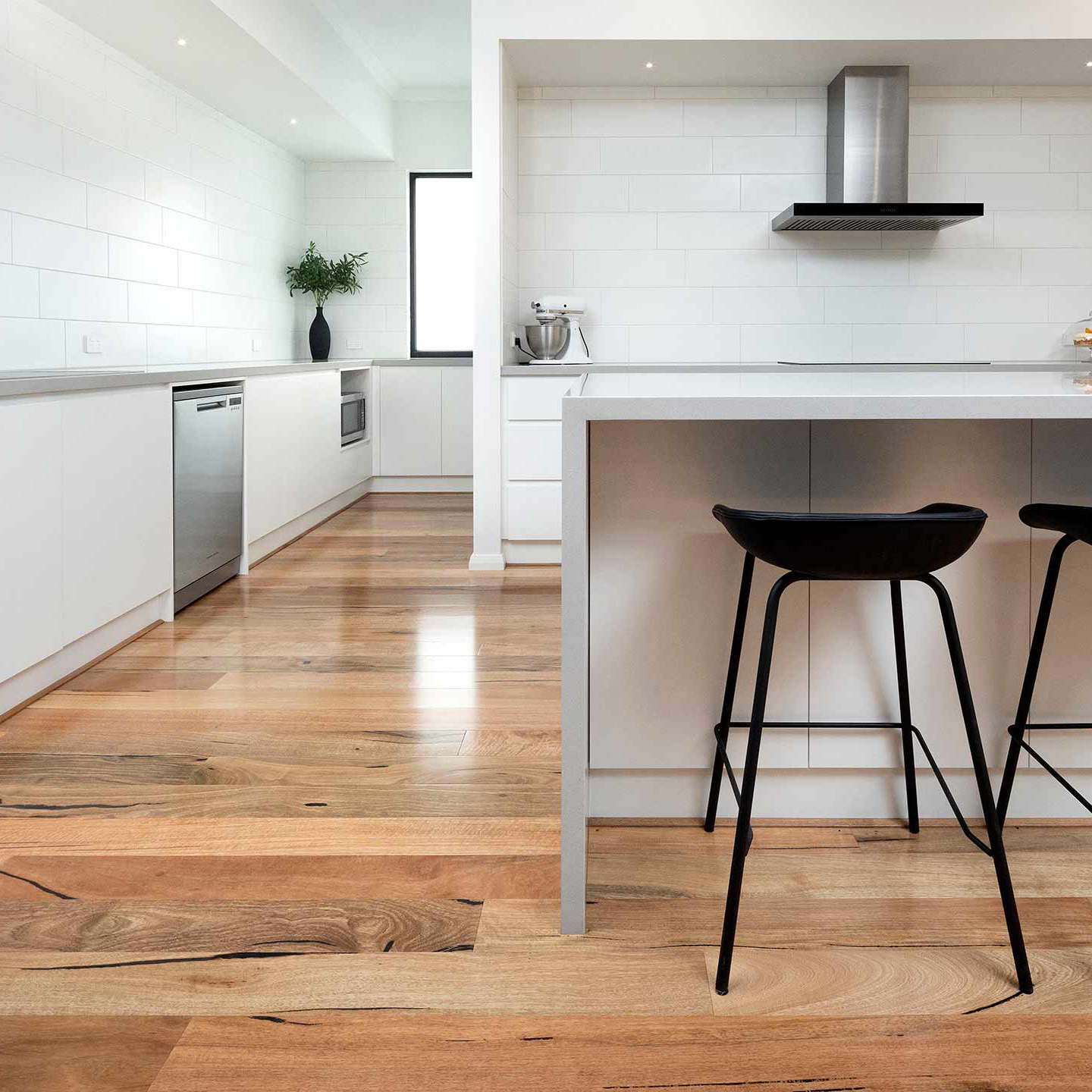
The recovery problem is the reason Marri flooring was uncommon for so long, and solving it is what made ours possible.
Open a Marri log and much of it cannot be used as a traditional floorboard — cracks, split gum veins, rot, termite attack. Less than 30% of the log becomes conventional flooring.
Our Stabilised Solid® process recovers 65 to 75% of the same log. The pieces high in gum vein, or carrying insect holes, splits or discolouration, go into the middle layer and the back of a three-layer board, reinforcing the top layer rather than being discarded. Having three layers is what lets us use the whole log.
As a floor, Marri is prefinished, 15mm overall with a 5mm Marri wearing surface, direct stick to a slab, and re-sandable a minimum of three times. The gum veins are filled by hand with black epoxy resin at the factory before the boards ship.
It suits normal family living. It is the softest of the three Australian species we sell, so a household with large dogs is better served by blackbutt — and we say so.
If you are weighing it up for a Perth home, the Marri timber flooring page has specifications and current pricing, and the Lifewood price guide covers the whole range. Or call the showroom and ask.
Quick reference
Botanical name: Corymbia calophylla. Formerly classified as Eucalyptus calophylla.
Distribution: south-west Western Australia only.
Density: approximately 855 kg/m³ seasoned.
Janka hardness: 7.1 kN.
Colour: pale honey and cream through to deep brown, with dark gum veining.
Common names: Marri, WA red gum.
Typical uses: furniture, cabinetry, flooring, turning. Historically, woodchips.