
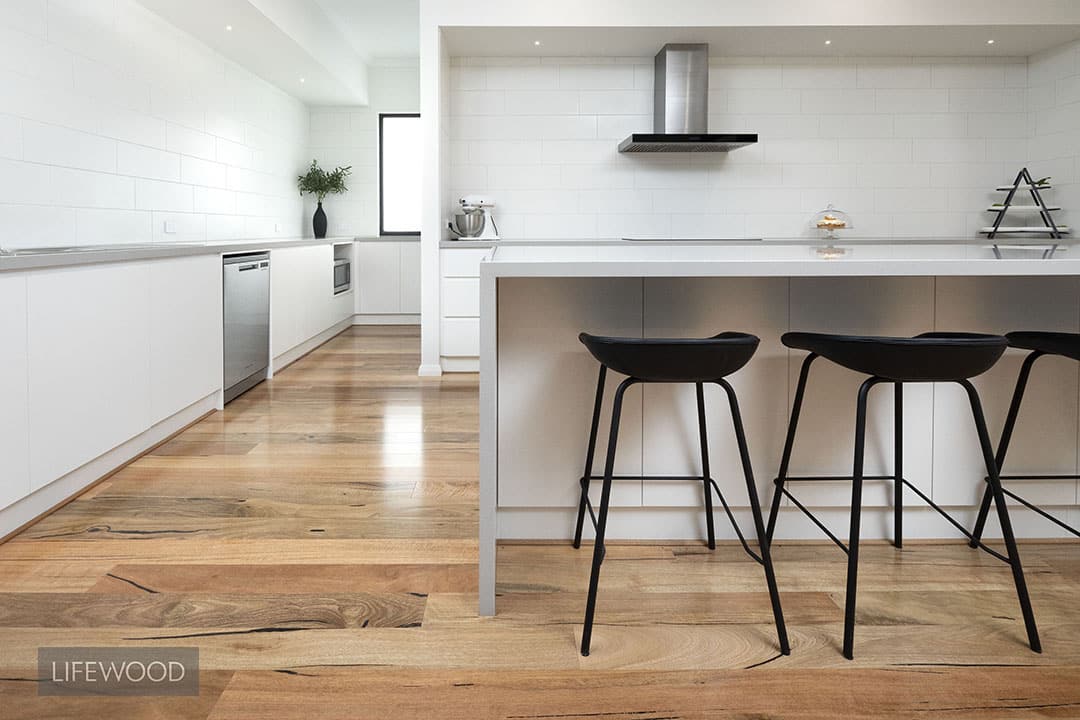
Yes. You can still buy Marri flooring in Western Australia, and we still make it in two widths. The 2024 logging ban applies to public land, and our Marri has never come from there.
It comes from trees that were being cleared anyway, on private land the ban never covered.
What the ban actually covers
On 1 January 2024 Western Australia stopped commercial native forest logging. The Forest Management Plan 2024–2033 governs about 2.5 million hectares in the south-west — state forest, timber reserves, national parks, conservation parks and nature reserves.
The Forestry Minister said at the time that he could not guarantee there would be "jarrah floorboards for everyone across the state." That sentence is why you are reading this page.
What it does not cover
The Forest Management Plan applies to public land. Private land is not included.
That is the sentence almost everybody misses, and it is the reason Marri flooring still exists as a product rather than a memory. Marri grows on freehold farmland across the south-west, and taking it there is lawful, ongoing, and regulated under an entirely separate system.
It is not a loophole and it is not an exemption. The ban never applied to that land in the first place.
Where our Marri comes from
Two sources, and the majority is the second.
Some is recovered ahead of approved mining — bauxite and rare-earth operations in the south-west.
Most comes from farmers. Clearing fence lines to make them safe against fire. Opening paddocks for grazing, or a dam, or avocados. Salvaging paddock trees that came over in a storm. This is very common practice for south-west farmers and it has nothing to do with the timber industry.
A lot of those logs were historically pushed up and burnt, or sent to the chip. The greater majority were simply wasted. We are grateful to be able to salvage them and make something beautiful out of them.
Two permits stand behind every log
Western Australia regulates this more tightly than most people assume.
The permit to cut
Under the Environmental Protection Act 1986, felling a native tree here is legally clearing — the Act defines it as killing, removing, severing or ringbarking native vegetation. There is no exemption for commercial timber on private land. The exemptions that do exist cover firewood and farm materials, cap the whole property at one hectare a year, and require that the vegetation is not killed. That is not a log supply.
A commercial harvest needs a native vegetation clearing permit from the Department of Water and Environmental Regulation, assessed against statutory clearing principles with conditions written for that particular site.
The licence to sell
Cutting lawfully is only half of it. Selling native timber taken from private property needs a private land supplier's licence from the Department of Biodiversity, Conservation and Attractions, granted only where the taking was lawful.
Both documents are held by the farmer, not by us. Farmers are conservative, unobtrusive people and they generally will not have their properties identified, which is why you will not see permit numbers published on this page.
What I can tell you is that logs cannot legally be cleared, felled or sold in this state without them, a logging contractor cannot ship to us before the farmer holds them, and the fines and legal consequences for taking a single tree without one are large enough that nobody here is willing to take the risk. Every consignment is inspected by a government official in Perth before it ships.
The part I would defend hardest
Marri's real story is not the ban. It is what happened to the species for forty years before it.
Between 1975 and 2021, around 10.6 million cubic metres of Marri was sold in Western Australia. Roughly 95% of it went out as woodchips.
Not because nobody wanted it. Because conventional milling could not get enough usable board out of it.
Open a Marri log and much of it cannot be used as a traditional floorboard. Cracks. Gum veins split open. Rot. Termite attack. Less than 30% of a Marri log can be used as conventional flooring.

Using the whole log
Stabilised Solid® recovers 65 to 75% of the same log.
The pieces high in gum vein, or carrying insect holes, splits or a little discolouration from rot, all get used — as small pieces to reinforce the middle layer, or on the back to reinforce the top layer. Having a three-layered board is what enables us to utilise the entire log.
It is basically the only flooring technology I have seen that responsibly uses the Marri log without discarding it to the waste pile or the chip pile.
The species that was pulped for forty years is the species we make floors from. I invented the process to do it, and of everything Lifewood does, that is the part I would defend hardest.
Current pricing is in the Lifewood price guide. If you want Marri for a job this spring or summer, call us now rather than later — the reason is in the next section.
What scarcity means for you in practice
Both widths are in stock today. That will not always be true, and Marri is not a species you can order at short notice.
The rule of thumb is three to six months lead time for any Marri you need for your project.
The range is also changing. The 130mm is being discontinued and a wider range — 180mm and 220mm — arrives in January 2027. If you are matching an existing 130mm floor, talk to us before January.
Marri is a continuing range. Some of our species are being sold down; Marri is not one of them.
Ask your supplier
Most flooring suppliers answer the sourcing question with an adjective. "Sustainably sourced", with no number and no document behind it, is not an answer. It is a hope.
So ask. Ask where the log came from. Ask what permit allowed it to be cut, and what licence allowed it to be sold. Ask how much of the log became floor.
If a supplier cannot tell you, that is information too.
Come and see the timber at our Osborne Park showroom, where Marri sits beside everything else we sell, or read the full specifications on the Marri timber flooring page.