Engineered Timber Flooring
Engineered Timber vs Hybrid Flooring
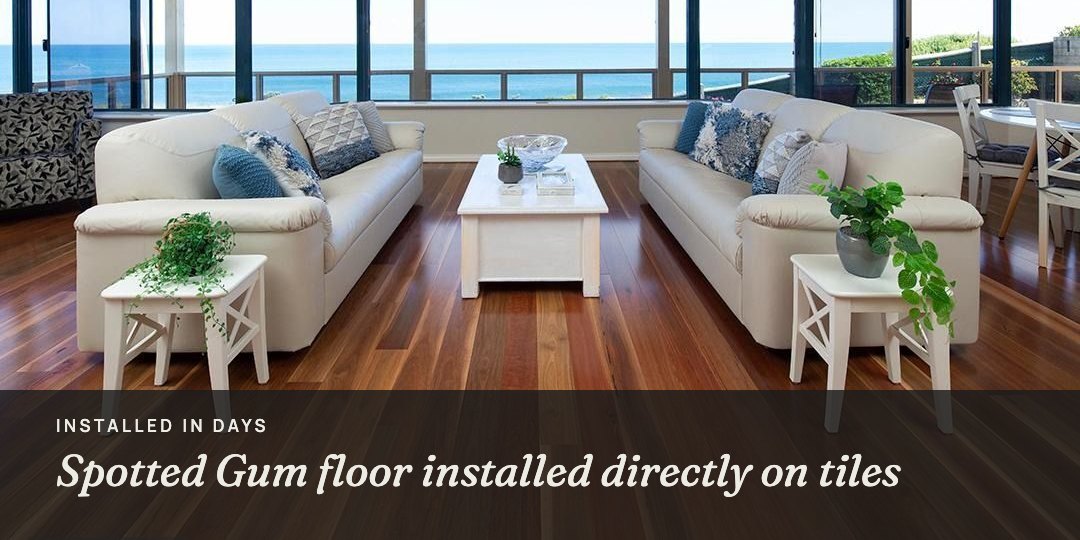

Yes. Over more than 20 years, Lifewood, and Bamboozle before it, has glued hundreds of timber floors straight over existing tiles across WA and Australia. No structural failure in that time. No warranty claim on a floor laid over tiles either.
It works when the tiles are firmly stuck down and flat, or made flat. When they're loose, hollow or badly uneven, they come out.
About two-thirds of our customers still choose to take them out. The method isn't the reason. Here's how to decide.
Halls Head: New South Wales Spotted Gum glued straight over the home's existing tiles in 2019 and 2020.
Not sure about your own tiles? Tell us about your floor or email a few photos to info@lifewood.com.au, and we'll tell you whether they can stay. Want it checked on site? Book a site inspection: our site supervisor checks the floor's flatness and moisture before any boards arrive.
"Tile flooring often looks flat when it's installed," says Mark Hutchison, Lifewood's founder. "But once you actually put a straight edge on the floor, you'll often find the tiles follow the contours of the subfloor underneath."
A tile can sit a millimetre proud of its neighbour. A grout line dips. If the slab wasn't levelled before tiling, every undulation carries straight through.
Our engineered boards, Stabilised Solid® and Nature's Steel®, are stiff. They won't bend to follow those highs and lows.
That stiffness is part of why the floor feels solid underfoot. It's also why the surface under it has to be right. The industry limit for a glued floor is 3 mm under a 3 m straightedge, set by the Australasian Timber Flooring Association (ATFA).
Tiles are prepared for a timber floor in four steps: check every tile is bonded, grind off the glaze, flood-fill any low spots, then glue the boards down. It follows the industry guidance on installing over existing surfaces.
It's the same method for every floor we lay over tiles, from our Australian hardwoods to French oak and American walnut.
Slate is the exception. It's too uneven to glue timber to directly. Flood-fill it and level it first. Then the timber goes down.
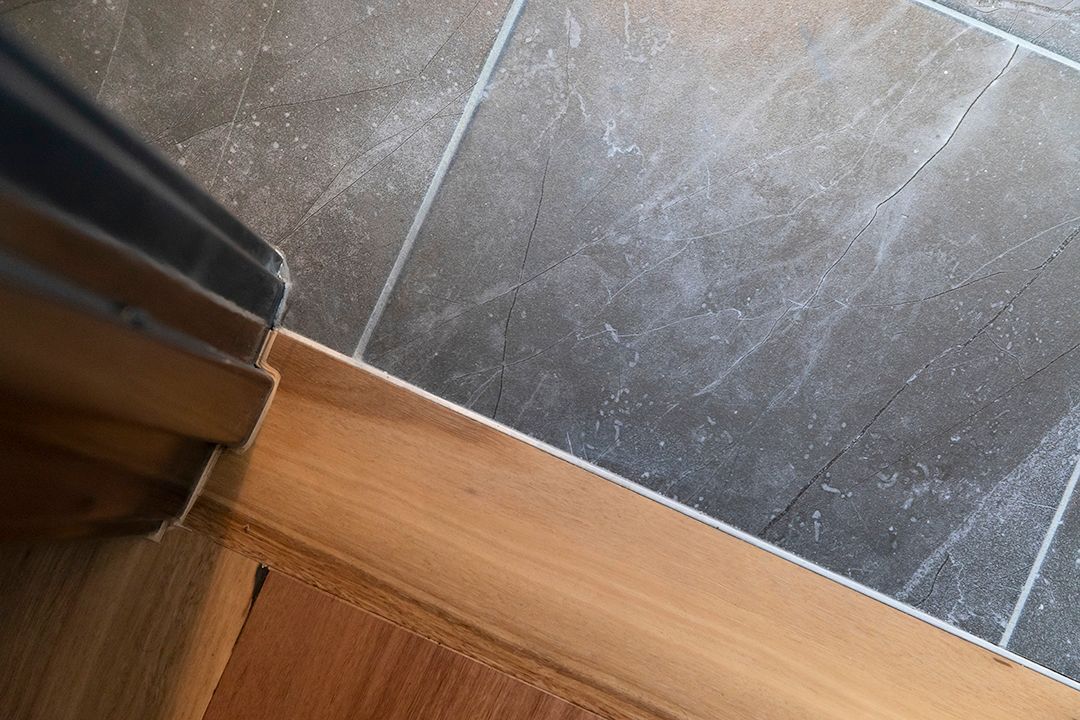
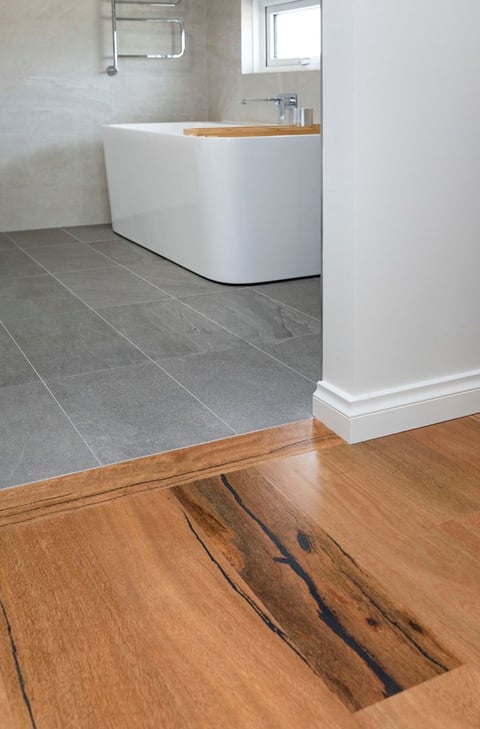
A timber floor laid over flat tiles sits 18 to 21 mm higher than the tiles. That's the board plus the glue. Our boards are 15 mm or 18 mm thick, and the adhesive adds about 3 mm. A flood-fill adds the thickness of the compound.
That height matters wherever the timber meets another floor: the laundry, a bathroom, bedrooms, carpet. At each of those, we fit a ramp board (also called a transition or header board) in the same timber, to step the floor down neatly.
Check your doors too. A floor 18 mm higher may mean trimming them. Fire-rated doors, found in some apartment buildings, need a gap of 3 to 10 mm under the door, and only a certified fire door installer can trim and recertify them (ATFA fire door guidance).
Keep the tiles if every one is firmly bonded and the floor is flat, or can be made flat. Take them out if they're loose, hollow or far from flat, or if you want one floor height through the house.
Leave the tiles down when:
Take them out when:
"If you want to keep the floor lower to the ground and you want to avoid the hollow spots, then the best thing is to take the tiles out and start from a fresh, clean slab," Mark says.
About two-thirds of our customers do. Most want the lower, even floor. And once the whole floor is costed, leaving the tiles down saves less than people expect.
Keep them or lift them? Send us a few details about your floor and we'll tell you which, or bring photos of your tiles to our Osborne Park showroom.
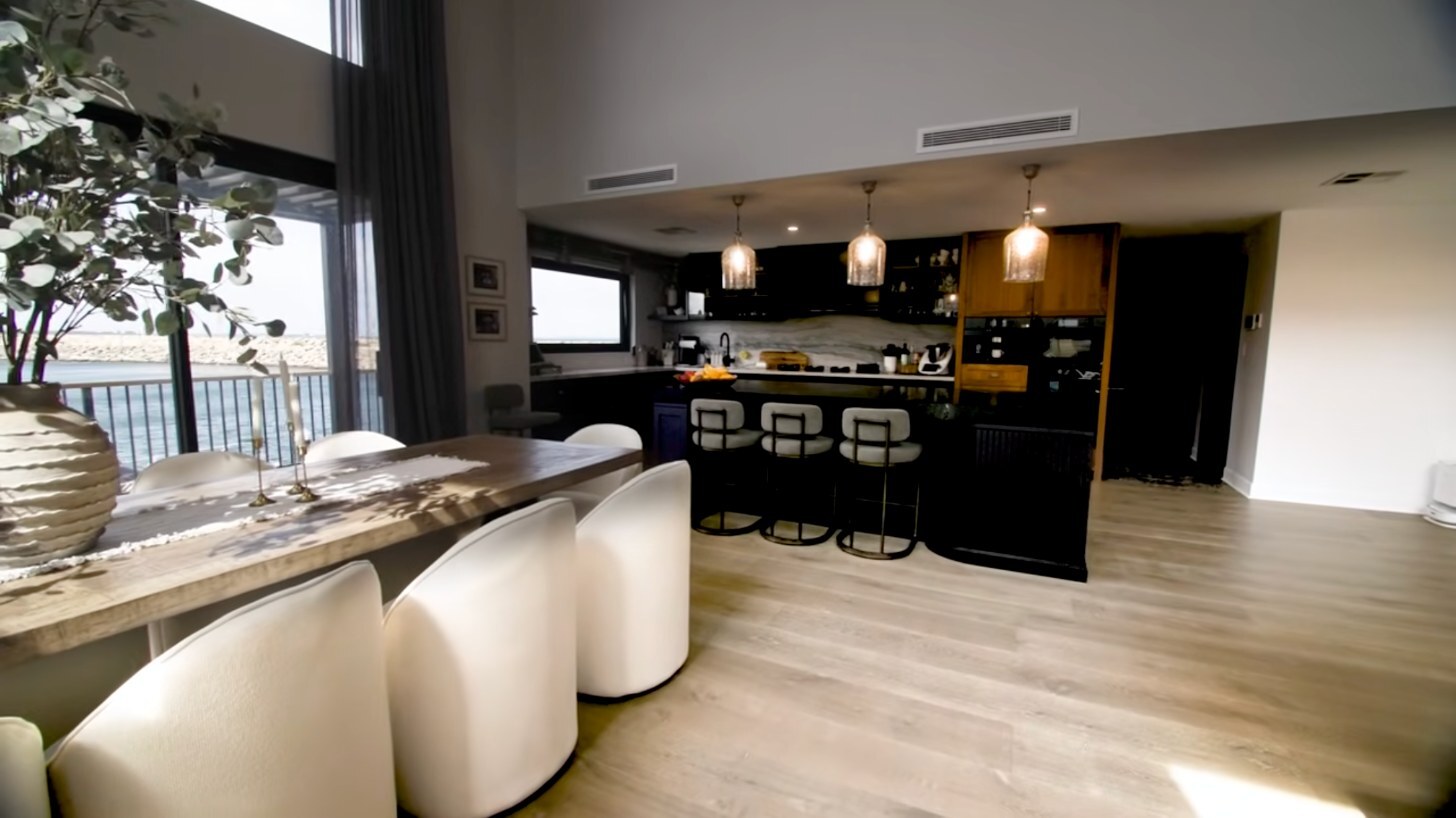
Secret Harbour: Marri over terracotta tiles. We laid 62 m² of 180 mm Marri straight over this home's existing floor tiles. The floor runs from the front door, down the hallway and into the open-plan living area.
First, the tiles were ground back to break the glaze. Low spots and gaps were filled with levelling compound. Then moisture was checked with a meter.
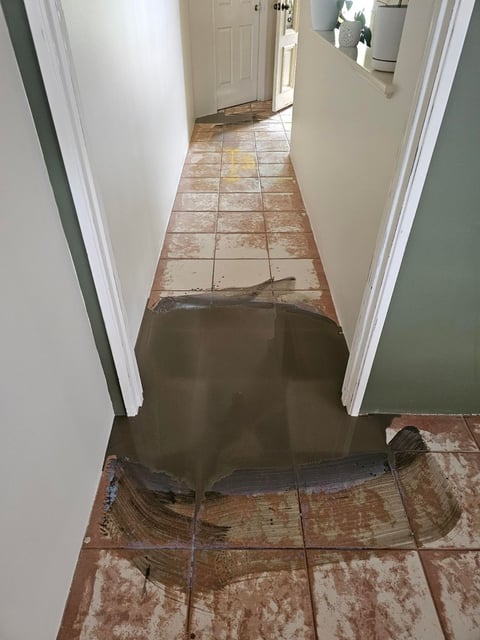
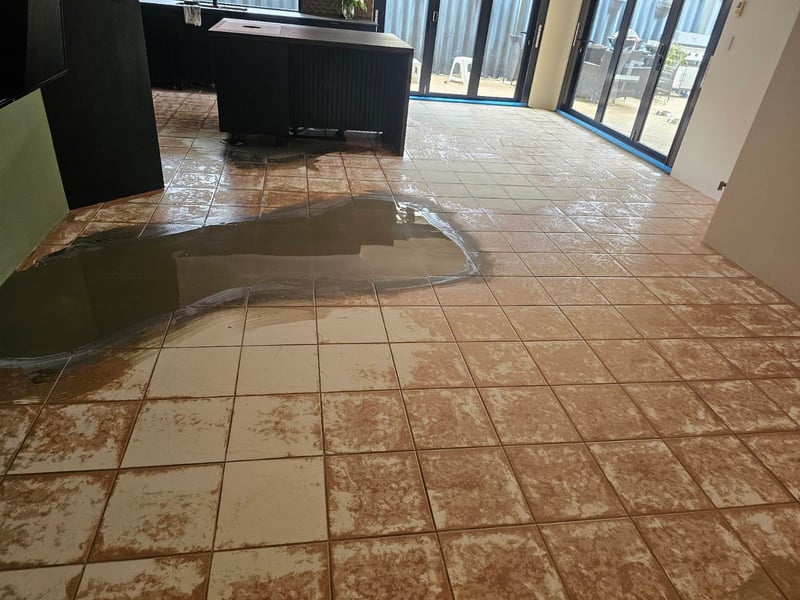
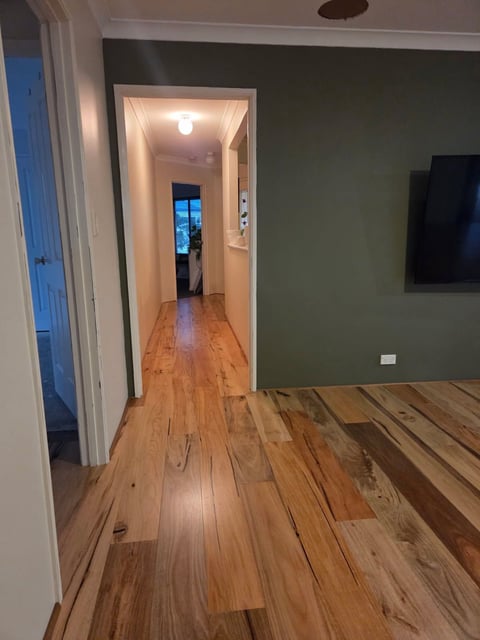
Secret Harbour: 180 mm Marri, laid straight over the existing tiles.
Halls Head: Spotted Gum over tiles, six years on. In 2019 and 2020 we laid 79 m² of 130 mm New South Wales Spotted Gum over the existing tiles in this coastal home, along with the staircase. It's the floor in the video at the top of this page.
It has never come back to us with a claim. Neither has any other floor we've laid over tiles.
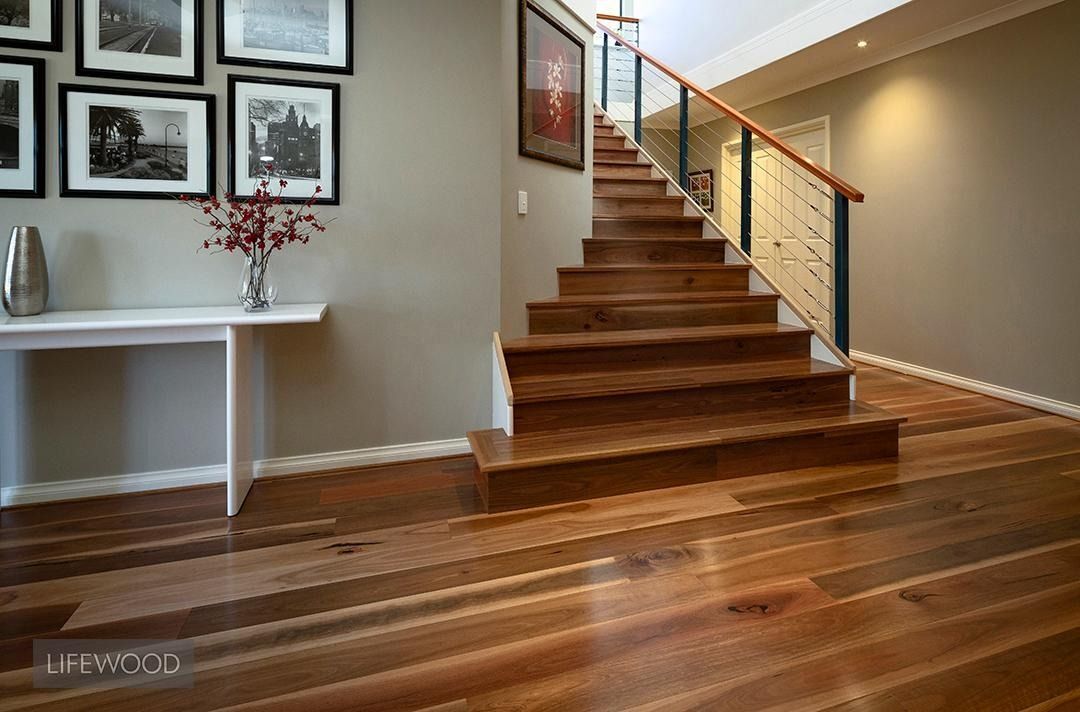
Halls Head: New South Wales Spotted Gum on the floor and the staircase.
In Perth, removing tiles usually costs $30 to $50 per m², and flood-filling them costs roughly $15 to $25 per m².
Flood-filling about 100 m² of tiles is usually a day's work. It costs roughly $15 to $25 per m², or around $2,000 for 100 m². More if the tiles are in poor shape.
Taking tiles out usually costs $30 to $40 per m², sometimes up to $50. Slate can be $50 per m² or more. It's dusty and noisy. It also adds time to the job.
Check exactly what that price covers. Many tile removal and demolition crews lift the tiles and stop there. Some leave the old adhesive on the slab. They don't grind, patch and level it to the 3 mm over 3 m a glued timber floor needs.
"Ask the contractor: at that price, are you going to patch and grind the floor and level it so it's suitable for timber flooring?" Mark says. "Some will say no, I only take out the tiles."
If the answer is no, allow another $20 to $40 per m² to get the slab ready. Our subfloor preparation page explains what that involves.
On a 100 m² floor, removal alone can cost $500 to $3,500 more than a flood-fill. More again if the slab still needs grinding and levelling. The boards themselves run from $129 to $259 per m², supply only, GST included. Against that, most people care more about the finished height and feel than the saving.
Every price for every species and width is in the 2026 Lifewood price guide.
A timber floor glued over tiles can sound hollow in places, unless the tiles are flood-filled first. Tiles are rarely flat. Glued straight over them, a floor has more hollow-sounding spots than one on a slab prepared to 3 mm over 3 m.
The floor is still structurally sound. The board is simply bridging a low spot.
A floating floor over tiles is a different matter. Laminate, hybrid and floating engineered boards rest loose on an underlay. The whole floor can sound drummy, which is why hybrid flooring sounds hollow. Every Lifewood floor is glued down. That keeps the hollow spots few and small.
"If a floor sounds hollow, it sounds cheap. If it sounds solid, it feels expensive," Mark says. Take your shoes off in our Osborne Park showroom and listen for yourself.
Slate, apartments, old vinyl floor tiles and moisture are the four situations that change whether timber can go straight over tiles.
You can do most of this in ten minutes:
Then bring photos of your tiles to our showroom at 1/18 Hector Street West, Osborne Park. Appointments take 30–45 minutes and Tony can usually quote the same day. Book a showroom consultation, send us an enquiry or call (08) 9445 9011. We'll tell you whether your tiles can stay, and what it'll take.
Yes, if the tiles are firmly bonded and flat, or flood-filled to make them flat. Over more than 20 years, Lifewood, and Bamboozle before it, has glued hundreds of timber floors over tiles across WA and Australia, with no structural failure and no warranty claim on a floor laid over tiles.
Not necessarily. Remove them if they're hollow, loose or badly uneven, or if you want one even floor height with no ramp boards. About two-thirds of Lifewood customers choose to remove them, because the saving from leaving them down is small against the cost of the whole floor.
Between 18 and 21 mm over flat tiles: a 15 mm or 18 mm Lifewood board plus about 3 mm of adhesive. A flood-fill adds the thickness of the levelling compound on top. Where the floor meets carpet, a laundry or a bathroom, a matching ramp board steps it down.
Preparing 60 to 100 m² of tiles usually takes one to two days, and laying runs at about 20 to 30 m² a day, so a 60 m² floor takes three to five days and 100 m² five to seven. You can walk on it the night it's finished, and the furniture usually goes back the next day.
Usually $30 to $40 per m², sometimes up to $50, and slate $50 or more. Check the quote includes grinding, patching and levelling the slab. If it doesn't, allow another $20 to $40 per m². Flood-filling the tiles instead costs roughly $15 to $25 per m².
In some spots, unless the tiles are flood-filled first, because tiles are rarely perfectly flat. A floor glued over tiles is still structurally sound. A floating floor over tiles sounds hollower, because it isn't fixed down at all.
Yes. Laying the new floor over heated tiles saves you the cost of reinstalling the heating, and tiles pass heat through well. The limit is temperature: the floor surface must never go above 27°C, the maximum set by the Australasian Timber Flooring Association (ATFA). Raise or lower the heating slowly, by no more than 1 to 2°C a day.
Lifewood has had no warranty claim on a floor laid over tiles in more than 20 years. What puts a floor at risk is laying it over tiles that are loose or hollow, which is why every tile is checked before a board goes down.
Come and stand on it.
Our flooring consultants are here to answer your questions, in person or on the phone.