Premium Timber Flooring
Australian Hardwood
Blackbutt Flooring

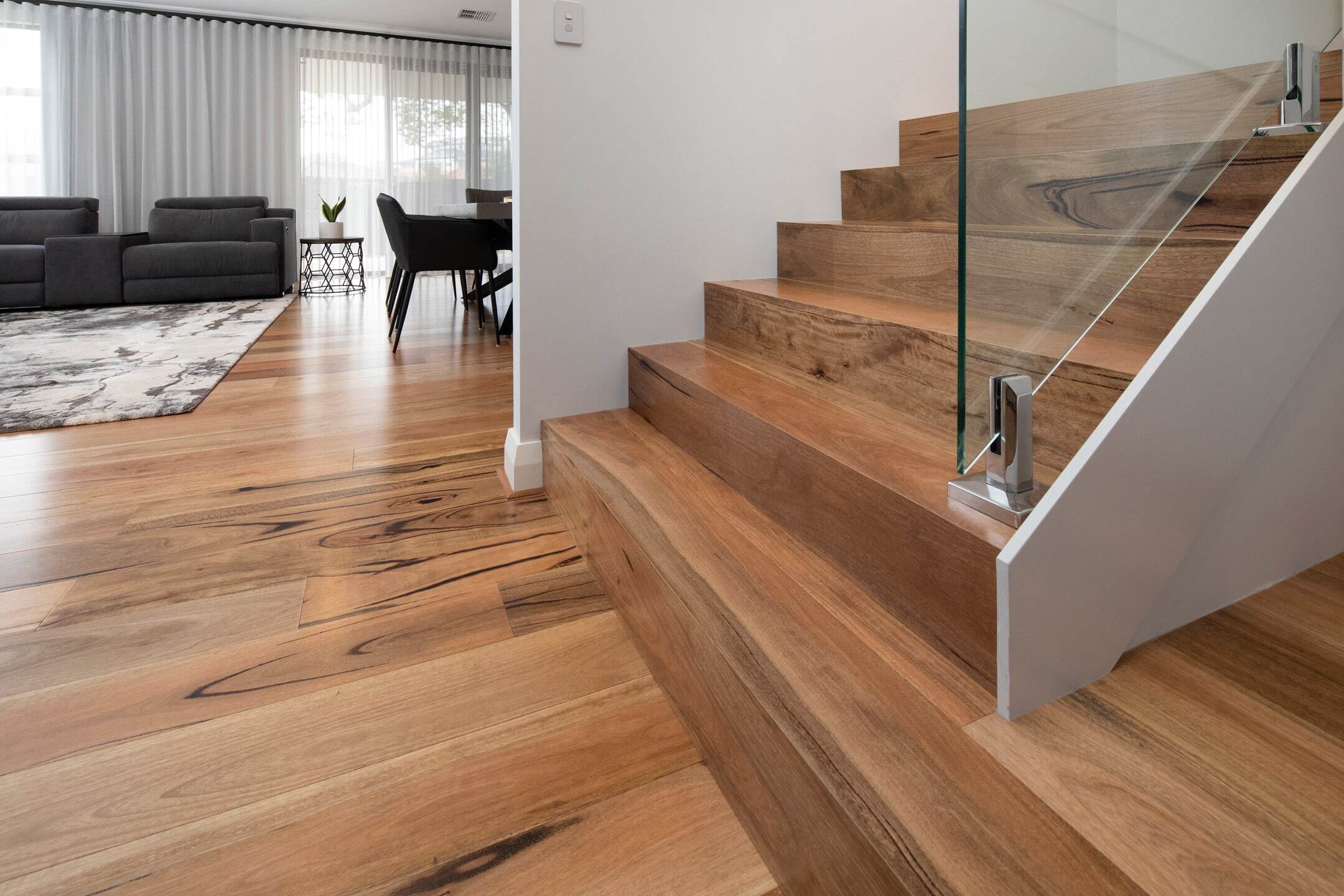
A Marri floor is laid board by board, chosen board by board. Before a single one goes down, the installer asks where your furniture is going and chalks it on the subfloor.
That sounds like a small thing. It is the difference between a floor that looks like a masterpiece and one that looks unacceptable.
Why Marri is harder to lay than other timbers
There are not many timber flooring craftsmen who have the skill to make Marri flooring look amazing.
Marri is the most varied floor we sell — honey through deep brown, with heavy gum veining. On a uniform floor like oak, board order barely matters. On Marri, board order is the floor.
Get it wrong and you get patches: three dark boards together in the middle of a pale room, or all the heavy gum vein landing in one corner. Get it right and the variation reads as movement across the whole room.
The distinction I draw is between a timber craftsman and a floor layer who specialises in laminate or hybrid. Both can lay a floor. Only one can lay this one.
Step one: talk to the homeowner before opening a pack
Ask where all the furniture is going. The rugs, the beds, the cabinets. Ask where the heaviest foot traffic will be.
Then chalk those positions onto the subfloor.
The reason is simple once you see it. Half the floor will end up under furniture or rugs. The parts people actually see — the walkways, the open spans, the spot inside the front door — are where the best boards should go. You cannot make that decision without knowing what the room is going to look like when it is finished.
Step two: unpack everything
Every floorboard comes out of the pack before installation starts, usually in the garage or wherever the cutting is being done.
You cannot select boards you cannot see. Laying straight from the pack is how a floor ends up blotchy.
Step three: sort, then deliberately randomise
Sort by length, by colour, by feature.
Then spread them back out — by length, by colour, by feature — so that no two similar boards are installed next to each other.
That is the part that takes judgement. You are not laying a floor, you are composing one. Each board goes somewhere specific for a reason, and as it comes together the floor becomes a masterpiece.
If it is not done well, it can look unacceptable. I would rather say that plainly than pretend every Marri floor turns out the same.

What happens before the boards reach you
All of this happens at the factory, before the floor arrives at your home.
Each gum vein is brushed out with a wire brush to remove the loose sap, sometimes with a small chisel where the vein is deep. Then brushed again. Then black liquid epoxy resin is poured into the veins and left days to cure hard. Only then is the board sanded and coated.
All of our Marri is filled by hand, sanded and processed. That is what "premium handcrafted flooring" means on our boards — it is a description of a process, not an adjective.
The honest note: we have had a customer or two whose black gum vein came out over time. It is less likely with the epoxy resin we use now, but it is not impossible. That is why the care kit includes black wax for the veins. What makes Marri beautiful also makes it challenging. There is more on that in the disadvantages of Marri, honestly.
If you are planning a Marri floor for spring or summer, talk to us early — give us three to six months lead time. Current pricing is in the Lifewood price guide, or call the showroom and we will walk you through it.
Laying Marri over existing tiles
We do this regularly, and the approach is the same as for blackbutt or oak.
The reason it needs care is counter-intuitive. Our boards are strong enough that they do not bend to follow the floor. And even though a tiled floor might look flat, it rarely is — tiles have uneven heights.
So the tiled surface is flattened with levelling compounds, then the boards are laid in a high-viscosity or semi-foaming glue that takes up the gaps under the tiles.
Skip that preparation and the floor telegraphs every high tile. The board's stiffness is exactly why the substrate has to be right.
The Perth risk nobody mentions
It is not the timber. It is water driven under windows and sliding doors in a winter storm.
We had a job where a storm flooded a new floor midway through installation — wind-driven rain pushed under the windows and sliding doors during heavy weather. That is a building envelope issue, not a flooring one, but the floor is what gets wet.
The response is to stop laying, let the floor dry out so the boards flatten, and fix the source before continuing. Not to push on. Any boards that do not return to the correct moisture content get cut out and replaced, the same as any other repair on a prefinished floor.
The lesson for a homeowner is simple enough: before your floor goes down, check that your windows and sliding doors are properly sealed and flashed. Especially heading into winter.
What to ask your installer
Whether they will unpack and sort every board before starting.
Whether they want to know where your furniture is going.
How they handle a slab or tiled substrate that is not flat.
The answers tell you quickly whether you have a timber craftsman or a floor layer.
Everything else on the species is in the complete guide to Marri flooring in Perth. Specifications and pricing for our Marri timber flooring are on the product page, and the boards are down at our Osborne Park showroom if you want to see the variation for yourself.