Australian Hardwood
Sustainable Flooring
Stabilised Solid

Search for Jarrah flooring and Google will show you a product at $22.90 and a product at $254.72 on the same screen, both called Jarrah. One of them contains no timber at all.
Nobody explains this, so I will. Four different things get sold as Jarrah flooring in Perth, and the gap between them is not a bargain. It is a category difference.
Roughly $22 to $48 a square metre.
These are vinyl or composite boards with a printed decorative layer. The Jarrah you are looking at is a picture of Jarrah, repeating every few boards, over a core that is not timber. They get sold as "Jarrah hybrid", "Jarrah SPC", "Jarrah look", and sometimes just as Jarrah.
What that means in a house:
We don't sell it. That is a choice about what we are, not a criticism. If your budget is $30 a square metre, hybrid is a real product doing a real job and you should buy it from someone who sells it well.
Price varies enormously, and so does what turns up.
This is genuine Jarrah, milled out of demolished buildings, bridges, wharves and old flooring. Much of it is old-growth timber of a density and colour that isn't harvested anywhere any more. For a heritage restoration in Fremantle or Mount Lawley it is often the right answer, and I will say so.
Things to know going in:
We don't sell recycled Jarrah either. It is milled to order by specialist reclaimed-timber yards and that is who you should buy it from.
Roughly $122 to $210 a square metre.
A board milled from one piece of timber, usually 80 to 130mm wide and around 19mm thick, secret-nailed to battens or a timber subfloor.
Two honest problems, and they aren't the ones people expect.
Supply is the first. Solid Jarrah has become much scarcer since this state stopped commercial native forest logging in 2024.
The Perth slab is the second. Most homes here sit on concrete. A solid board can't be direct-stuck to a slab — it needs a battened subfloor built over the top, which adds height at every doorway, adds cost, and eats ceiling clearance. That is a construction decision, not a detail.
Roughly $95 to $255 a square metre, and that spread tells you the category is not uniform.
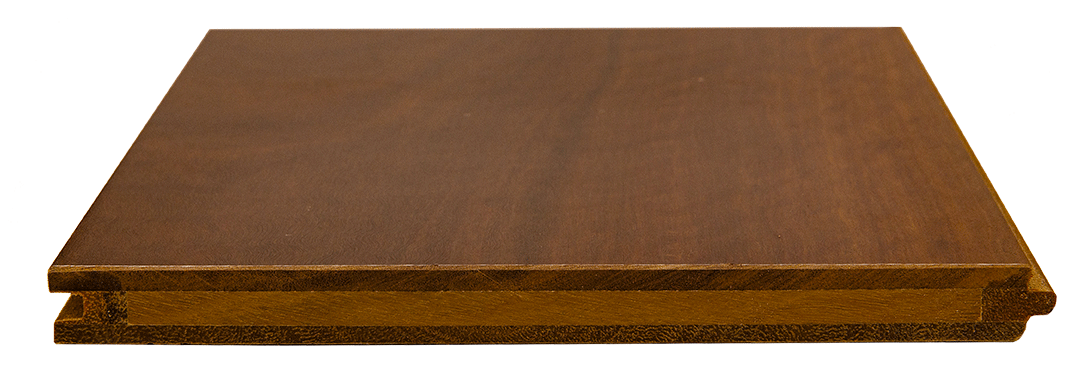
An engineered board is real Jarrah over a stable core. You walk on Jarrah. What sits underneath is built so the board doesn't move the way a solid board moves through a Perth summer.
The spread comes down to what the core is and how thick the Jarrah is, and this is where the category earned its bad name. A thin veneer over fibreboard and a thick timber surface over a hardwood core are both sold as engineered. We covered the difference in what's actually inside engineered timber flooring.
Three questions separate them:
Our Jarrah is Stabilised Solid® — three layers of 100 per cent hardwood from top to bottom, 15mm overall with a 5mm Jarrah wearing surface, direct stick to a slab, lifetime structural warranty. No plywood, no pine, no rubberwood anywhere in it. From $239 a square metre, boards only, GST included.
A new Jarrah floor is not the floor you will own.
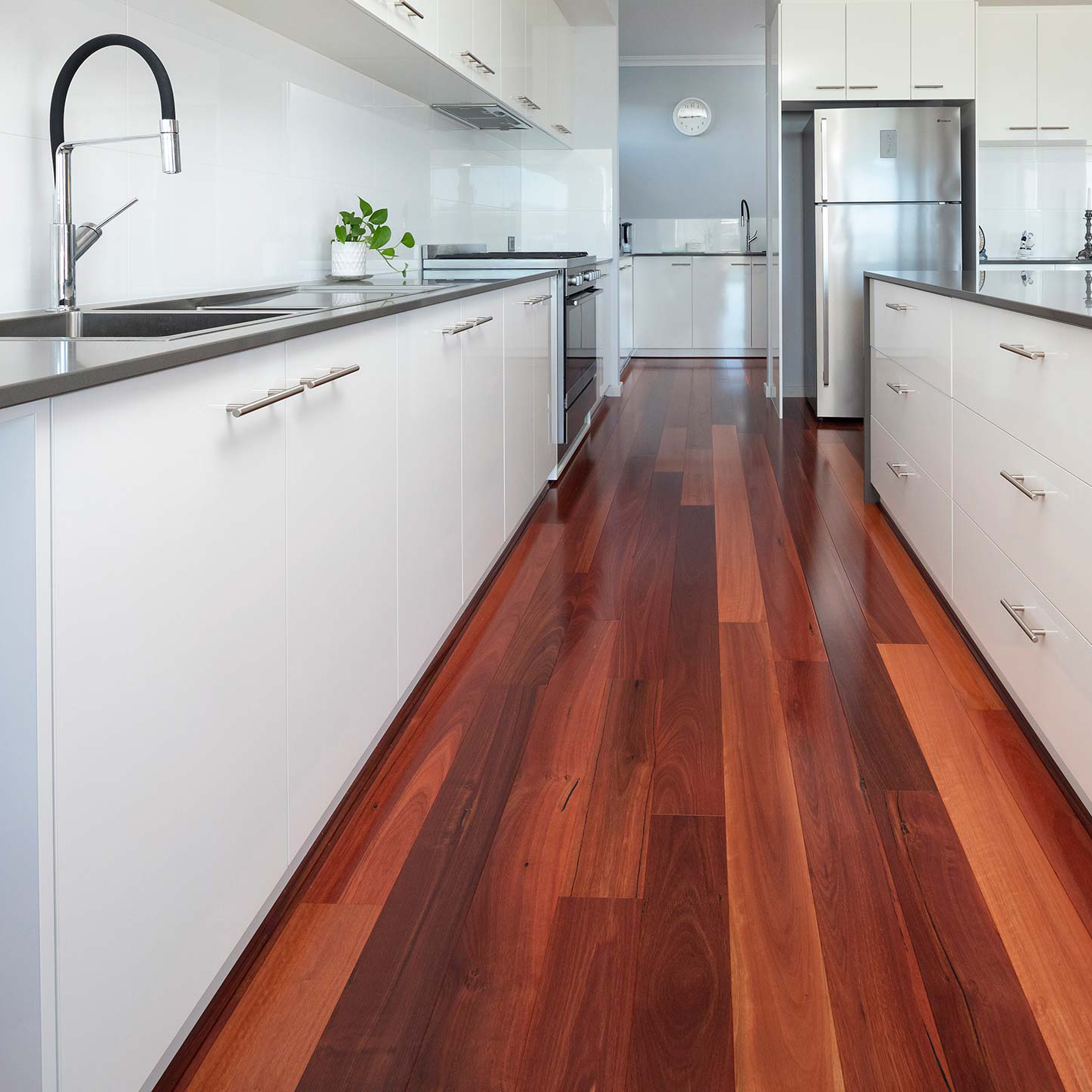
On the day it goes down it is varied — dark pinks through to chocolate browns, with the gum vein filled with black furniture resin. Over the first six to twelve months it settles. It becomes more uniform, and it darkens into that deep regal red people picture when they say the word Jarrah.
If you are the kind of person who needs a floor to look identical on day one and day one thousand, that will bother you, and I would honestly steer you towards an oak instead — more even in tone, far less inclined to move. If you like that a floor has a life, it is the best argument for real timber there is.
Four questions. Ninety seconds.
Then put two boards from different packs side by side. Printed products repeat. Timber doesn't.
Our price guide sets out Jarrah pricing and what a Perth job costs end to end. Or come and stand on the real thing at our Osborne Park showroom — Jarrah photographs badly and looks different under every light, so a screen is the worst possible way to choose it.
A hybrid or laminate "Jarrah" board is a photographic print of Jarrah over a vinyl or composite core. There is no timber in the wear layer, it cannot be sanded, and it will not match a real Jarrah floor because the pattern repeats and the colour is fixed. Real Jarrah, solid or engineered, has a Jarrah wearing surface that can be re-sanded and that ages the way the rest of your floor does.
Recycled Jarrah is milled from timber salvaged out of demolished buildings, bridges and wharves, and it is sold by specialist reclaimed-timber yards rather than by us. It is often the right choice for a heritage restoration where character and old-growth grain matter more than uniformity. We don't sell it, and we would rather tell you that than sell you the wrong thing.
Most Perth homes are built on a concrete slab, and a solid board cannot be direct-stuck to a slab — it needs a battened subfloor built over the top, which adds height at every doorway and eats ceiling clearance. An engineered board goes straight down, stays dimensionally stable through a Perth summer, and can still be re-sanded. If you have a timber subfloor and want the traditional board, solid still makes sense.
Because it settles. On the day it goes down a Jarrah floor is varied, from dark pinks through to chocolate browns, with the gum vein filled with black furniture resin. Over the first six to twelve months it becomes more uniform and darkens into a deep red. If you need a floor that looks identical on day one and day one thousand, an oak is more even in tone and far less inclined to move.
Come and stand on it.
Our flooring consultants are here to answer your questions, in person or on the phone.