.jpg?width=1080&height=720&name=15850_Spotted_Gum_180%20(8).jpg)
Australian Hardwood
Engineered Timber Flooring
Engineered Timber vs Hybrid Flooring
Spotted Gum Flooring: Durability, Colour, and Cost Explained

Mark Hutchison
Spotted Gum flooring is made of one of Australia's most durable hardwoods. Its high Janka hardness and density rating put it ahead of most flooring wood species for use in your home. It also possesses some of the broadest and most striking colour variations of any local timber and spans a broad price range. In this guide, we break down the three main aspects to consider when choosing flooring made of Spotted Gum, including durability, grades and costs for solid, engineered and hybrid types.
How durable is Spotted Gum flooring
Spotted Gum has a Janka hardness rating of about 11 kN and a dry density of around 1,010 kg/m³. In practical terms, that hardness measures how much force the surface can resist before it dents. At 11 kN, Spotted Gum is firmly within the ‘very hard’ band. It withstands the kind of daily punishment that can mark softer floors from dropped pans, dog claws, chair legs, kids' toys and the like. It’s one of the most resilient Australian hardwoods, suitable for busy living spaces, hallways and homes with big pets.
Durability isn't only a question of hardness. Spotted Gum holds a Class 1 above-ground durability rating with strong natural resistance to termites, so it stands up well over the decades without requiring chemical treatment. It’s also naturally fire-resistant and meets BAL-29 bushfire compliance without needing additional treatment. This is a big consideration for Perth-region properties within bushfire-prone areas.
The table below compares Spotted Gum against other popular timber flooring species:
Figures are indicative and sourced from the CSIRO Australian Timber Manual. Note that natural timber varies within any species.
The Spotted Gum colour story: understanding natural variation
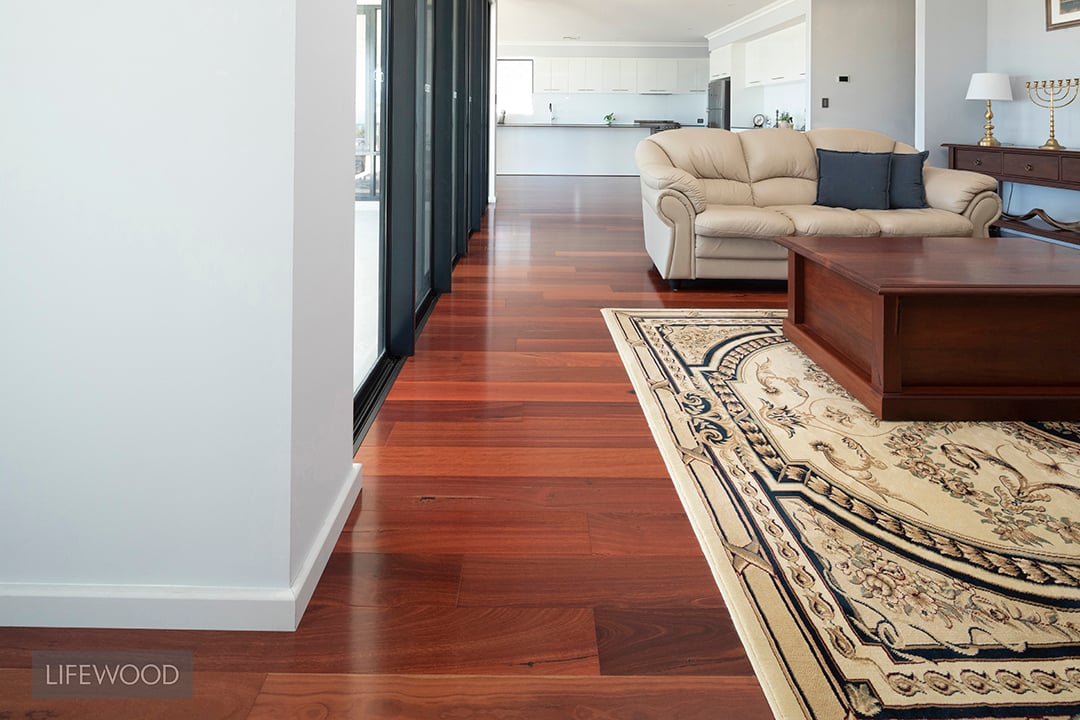
Few Australian hardwoods provide the vast tonal breadth of Spotted Gum. An individual floor can shift from pale honey and soft grey to warm browns to deep chocolate. This variation can even appear within a single board. A wavy, interlocking grain overlays this, creating a sense of movement and depth on the surface. The result? A floor full of character rather than a strictly uniform finish.
How much of that spectrum you see depends on the grade you select. Grade doesn't affect hardness or durability. Rather, it classifies boards by the number of natural features they have, which influences the look and price.
Select grade Spotted Gum
Select grade is sorted by the tightness and consistency of the colour palette. The flooring with fewer features (minimal gum veins and knots) is considered a higher grade as it looks clean and calm. This suits contemporary and minimalist interiors where you want the timber to feel refined rather than rustic. Because it requires more sorting to achieve that uniformity, select grade costs more per square metre.
Feature grade Spotted Gum
Feature grade embraces the entire colour spectrum of the timber, including visible gum veins and natural knots. It’s more affordable, looks warmer and busier, and feels textured underfoot. It’s a natural fit for coastal and Hamptons-style interiors, where the natural character of the timber is part of the appeal rather than something to be minimised.
What Spotted Gum flooring costs in 2026
Cost varies most by format. Solid Spotted Gum is the most expensive option. Spotted Gum engineered flooring sits in the middle. Spotted Gum hybrid flooring is the most accessible. As a guide, current Lifewood pricing across Australian hardwoods (covering Blackbutt, Spotted Gum and Grey Ironbark) ranges from about $89 to $329 per m² fully installed. Spotted Gum typically carries a 10–15% premium over Blackbutt due to its higher density and greater demand.
These factors affect the final price:
- Grade. Select grade costs more than the feature grade
- Board width. Wider boards increase the price
- Finish. The coating system and sheen level chosen
- Install method. Direct stick, floating or secret-nail
- Subfloor prep. Levelling and moisture control add to the job
For more details, see the Lifewood engineered timber flooring 2026 price guide.
Solid vs engineered vs hybrid Spotted Gum
This decision affects everything else. Spotted Gum comes in three constructions, and the appropriate one depends on your climate, home and budget.
Solid Spotted Gum floorboards are made of traditional, full-thickness hardwood. They have maximum sanding potential. But as a single piece of natural timber, it moves more with humidity variations.
Spotted Gum engineered flooring places a real timber wear layer over a stable core. Lifewood's Stabilised Solid® construction technology uses three layers of genuine Spotted Gum, with the middle layer running perpendicular to the others. You get the identical look and feel of solid timber, with markedly better stability. This is the most reliable choice for most Perth homes.
Spotted Gum hybrid flooring bonds a timber veneer over a rigid SPC or WPC core. It’s fully waterproof and extremely stable, so it’s good for wet areas. Still, it doesn’t give the same underfoot feel or have the refinishing potential of real timber.
So What is Spotted Gum Flooring?
Spotted Gum is a top-tier Australian hardwood, with exceptional durability, genuine termite and bushfire resistance, and a warmth and colour depth few other timbers can match. The best way to judge the texture and colour variation is in person. You can request flooring samples or book a Lifewood showroom visit to see our Spotted Gum range before you commit.
Frequently Asked Questions
How much does Spotted Gum flooring cost per m²?
As of April 2026, Lifewood's Australian hardwood range is approximately $89 to $329 per m² fully installed. The Spotted Gum is toward the upper pricing range. The cost depends on the format, grade, board width and installation method.
Is Spotted Gum harder than Blackbutt?
Yes. Spotted Gum rates around 11 kN on the Janka scale, as opposed to roughly 9.1 kN for Blackbutt. This translates to slightly better resistance to dents and scratches, great for high-traffic areas.
What's the difference between select and feature grade?
The grade depends on the colour range and visual character. Select grade has a tighter, uniform palette with minimal features. Feature grade displays the full spectrum, including gum veins and knots.
Can Spotted Gum flooring go in bathrooms?
Only hybrid Spotted Gum is suitable for wet areas, as it is fully waterproof. Solid and traditional engineered Spotted Gum are not waterproof and aren't recommended for bathrooms or laundries.
How do you clean Spotted Gum floors?
Sweep daily with a soft broom and wipe weekly with a well-wrung damp mop. To keep the finish protected, plan to re-coat the floor every five to seven years, depending on traffic.